Thursday, April 8, 2010

4th Death Sentence, continued

(Continued from where we left off)


After weeks of playing at being a revolutionary, hauling high explosives all over Warsaw without drawing so much as an unfriendly look from the police, my luck ran out.

It happened one evening when, in all innocence, I crossed the Praga Bridge. A gang of uniformed thugs came running out of the fog shouting at me, blowing whistles, waving guns, and more or less making it plain they desired to attract my attention.

I had nowhere to turn. If I jumped into the water, they could put enough bullets into me to sink me like a stone. So I stopped and waited with raised hands and a spotless conscience, and inquired politely what the fuss was all about.

After searching me from top to bottom, their officer condescended to let me know that, a few minutes earlier, a policeman had been shot coming out of the Smocza Street station house.

And what did this have to do with me?

An obliging eyewitness had given them a description of the assassin that may or may not have fitted me exactly. Meaning, I suppose, the perpetrator also had a head, two arms and two legs.
Not only was my conscience clear, but my emptied pockets revealed that I was not even carrying a revolver. This, to my captor, was added proof that I was their man. Why else would I have been strolling on the bridge if not to dump my guilty weapon into the water?

With all possible tact, I pointed out that people were also known to use bridges as a means of crossing a river. For this, the policeman slapped my face and told me not to be insolent as he hauled me in to the police station.

I spent nine cold and miserable days in a cell at the Smocza Street station before a lawyer hired by the Party attained my release by showing the police a week-old newspaper noting that the actual killer had been caught almost immediately and, in fact, had already been executed. But as the culprit had been taken to another station, no one at Smocza felt obligated to know anything about it.

Back home in my cellar, I dropped onto my mattress like a stone. Almost at once, a fist hammered on the door. It was Krinsky, a messenger from the Party who had come to express happiness that I was free again and, by the way, let me know I was due to take part in an “action” at five o’clock the next morning. Our target was a certain gang of pimps and strong-armed men with whom we occasionally had a “shoot-out.” He thought I’d be happy to know that the leader of this mob was Left-handed Stepan, whom I had long suspected of being a police informer.

But, starved for nine days’ sleep, I groaned, "Can't it wait a day or two?"

In a day or two, Krinsky pointed out, I might be back in jail as the police now know my face. And all I was being asked to do, with the help of an assistant, was lay siege to the police station on Smocza, the very one whose cells were still raw in my memory. And, anticipating that it might occur to them to telephone for help, we were to cut their wires.

Eyes sticky with broken sleep, I showed up at our post with my assistant. We saw at once that the phone lines were out of our reach. Neither of us had been told to bring a ladder.

While we tried to work out who should stand on whose shoulders, an unpleasant voice at my back ordered us to put up our hands. Without a moment’s hesitation, we both ran.

In the awakening street, not a soul turned his head, this being a neighborhood clearly accustomed to seeing men running from the police.

My partner, out of breath, ducked into an apartment house, but I felt confident I could outrun my pursuer. What I didn’t count on was his readiness to fire his rifle on a street crowded with innocent people.

Even before I heard the shot, I felt a stinging slap against my leg. I managed to keep running, but my heart hammered with fear.

To be continued

Monday, April 5, 2010

The 4th Death Sentence

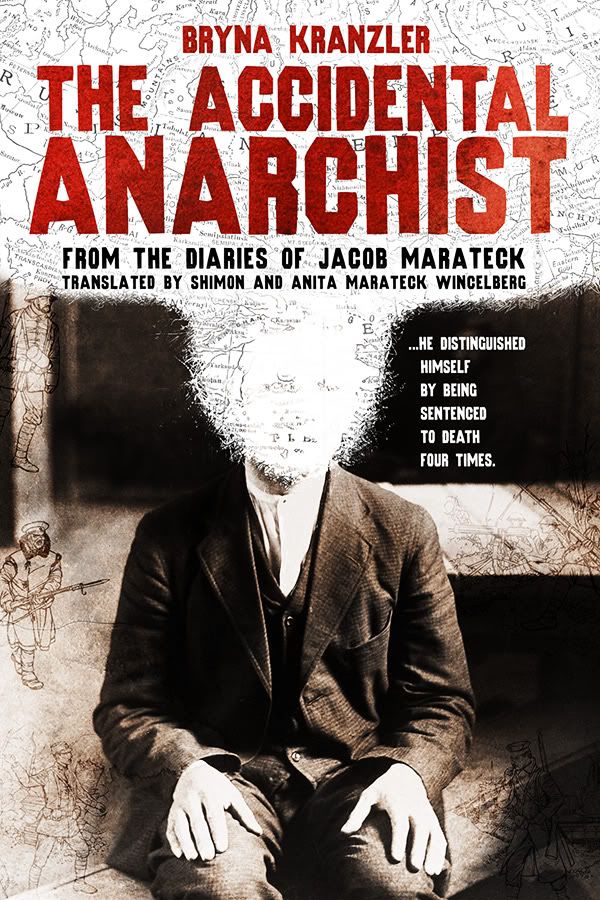
Thank you, readers, for your patience during the last few weeks when I didn't have time to post anything but the book covers for voting. I've collected the feedback from a variety of different sources, including buyers for independent bookstores, and the choice became increasingly clear (see image of final cover, below). Thank you for providing feedback during this important test.

I mentioned that I was busy. Yes, I've been working with the book jacket designer, a talented graphic artist who happens to be in Russia, and an astute editor who happens to be in Australia. (It's not a small world; it's a virtual world). I'm pleased to report that soon the graphic designer will be working on the layout of the text -- 'soon' being as soon as I stop working on it. While I was pleased to learn that my editor said that the book is a fun, fast-paced read, there are still areas that need work, and that's where my focus has been. I've also been tracing my grandfather's route from Petersburg to the various battlefields in the war, making sure that the information I have is in the correct order, according to which battle to place where and when, and in which direction they were moving at the time (the latter mostly pertains to the escape from Siberia). 

Meanwhile, I thought it was time to share the story of my grandfather's fourth death sentence, which came closest to execution (pun) than all the previous ones. As all of this will be in the book, I'm posting only portions of that information here.

Background: Following his return from the Russo-Japanese War, my grandfather and many others were thoroughly disillusioned with the Russian government (where anti-Semitism was an official policy) and its inept army. While he had wanted to launch a revolution before the war (and many believe that the Russo-Japanese War was prompted by Russia to distract the populace from their dissatisfaction with their government -- sound at all familiar . . ?) he returned even more determined to upset the social order and overthrow the Czar.

Once he was back in Warsaw, the first order of business was deciding which of the many revolutionary parties to join. Since my grandfather had earlier been involved with the Bund, a Jewish Socialist Party, he was quickly invited to rejoin them, without pay (much as my college graduate son has been getting great opportunities to work for nothing during this recession). The following is from his experiences with the Bund:

I was sent on various, strange errands. To keep them properly cloaked in secrecy, each mission was organized in a manner so melodramatic that any policeman with half a brain should have collared the lot of us within the first half hour.

One morning, I was summoned to the Bristol Hotel, a place ordinarily out of my class. I saw from a distance that its lobby was densely populated with Czarist agents.

My assignment was to make contact with someone holding one end of a broken match; I was to carry the other half. After confirming that our pieces fit together, the man would say to me in Polish, “Excuse me, sir, can you give me a light?” To which I would reply, “What brand of cigarettes, sir, do you smoke?”

It did no good to point out that such a dialogue would be hard to mistake for a casual exchange between two normal human beings. To make things worse, I was given a piece of the wrong match, meaning that each of us would arrive carrying half a match without a head. My handler agreed there may have been a slipup, but it was too late now to alter the arrangements.

Picture two shabbily dressed strangers circulating in the crowded lobby of this elegant hotel, stooping over, from time to time, to gaze at what each other person held between his fingers. After sweating through I don't know how many minutes of this little minuet, my contact and I finally noticed each other’s peculiar behavior, and sheepishly flaunted our headless matches. We then recited our stilted passwords and managed to walk out together, all without arousing the suspicions of our excellent police force.
In the street, my fellow plotter, a jittery, young man with bad skin, kept looking over his shoulder. Half a block away, when he finally felt it was safe to talk, said, “Are you prepared to go on a mission?”

“What kind of a mission?”

He yanked me into a doorway. “I can't tell you.”

”Then I'm not going.”

“All right,” he said grudgingly. “Delivering supplies.”

“Supplies of what?”

Scowling with annoyance, he mumbled, “Ammunition.” His tone let me know I had no business asking such an idiotic question.

While the task sounded harmless enough for someone of my background, I knew of several comrades who had been arrested while transporting such goods and, with very little fuss, sentenced and shot.

But my contact allowed me no time for reflection, snapping, “Wait here,” as he vanished across the street.

Trapped, I loitered in plain sight of the Bristol, straining to look invisible and braced, at any moment, for a heavy hand to fall on my shoulder.

Instead, I saw a tall young woman make her way daintily through traffic. Flustered, she stopped near me and looked around. This, I assumed, was my new contact since one would have had to be blind not to have spotted her instantly as a man in a poorly fitted horsehair wig. Nor was he too cleanly shaven.
I tried to lose myself among the passing pedestrians, hoping this person in a pavement-trailing skirt and high-heeled boots would not be able to follow me.

But the creature in the wig caught up with me. Smiling through smudged lips, he motioned coquettishly with his finger. Resigned, I allowed him to capture my elbow and summon a droshky. We climbed in, and he directed the driver to a certain number on Shliska Street. The driver cracked his whip, giving no sign of having noticed that his orders came from a woman with a rather hairy voice.

We pulled up at a shoemaker’s cellar where my contact, with the nonchalance of a commercial traveler on an expense account, ordered the droshky to wait, as if we had not been warned time and again that some cab men also served as police informants.

A minute later, I staggered back out into the street hauling two valises so heavy that one of the handles promptly came off in my hand. My load crashed to the pavement.

At this, the shoemaker turned white, and then became hysterical. Hopping up and down, he cursed my clumsiness and consigned me to the seven depths of hell. I realized that I was not carrying mere bullets but a more nervous kind of merchandise, like dynamite or homemade bombs, the kind we cozily called “dumplings,” some of which had been known to go off at inconvenient times.

Still in his wig and padded dress, my contact ordered our driver to take us to a windowless shack outside the city and deep in the woods where, to my relief, a refreshingly businesslike couple accepted delivery of the supplies.

To Be Continued

Tuesday, March 30, 2010

Voting Continues, but there's New Blog Content

"Thank you" to everyone who voted on the covers. I've posted a slight revision to two of  them, and will leave the voting open for a while longer. But in the meantime, I'll fill you in on what's new.

I got my application in to the Jewish Book Council in time for them to consider it (and me) for their Meet the Author event at the end of May. At that time, those who are invited to participate (at our own cost, but it's worth it) will make a 2-minute presentation to the coordinators of the Jewish Book Fairs from around the country, and selected reviewers, and be available to answer questions. About a month or two after that, invitations start going out to the authors that individual cities' book fairs invite to their events, which take place from late October to early December. With the hope and expectation that I will be invited to present, I now need to put together a bang-up presentation for May, and while I'm confident that I can put together the content, I'll probably need to look for some coaching help. Have emails out to a couple of recommended publicists, and await their responses.

Meanwhile, while I felt I was on schedule to get everything ready to print in April so I can get 100 copies of the galleys to the Jewish Book Council (again, I'm acting optimistically on the assumption that I'll be included) when two people I trust told me that it was essential that I find an editor to read the manuscript before I submitted it. Hadn't budgeted for that time-wise or cost-wise, and though I questioned whether it was absolutely necessary, I realized that it would be foolish to have spent all this time on the book and mess up because of typos or grammatical errors.

So I went back to Elance, a site at which one can post jobs to be bid upon by people in artistic fields (and was where I found my incredibly talented graphic artist), and feel that I found another gem, who is almost finished reading the ms. Meanwhile, I'm STILL writing the first chapter, the most critical of all, and my artist feels comfortable with the time I estimated I could get the manuscript to him for layout.

What's also in the works is that Elie Wiesel has agreed to provide a blurb after he gets the galleys. When I have that, I have a few people in mind from whom to solicit quotes, too, but having one from Elie Wiesel will give me the credibility that I need in order to approach the other authors.

At the same time, I have continued getting feedback on the covers, both online here (voting still open) and individually. In particular, I've gone to a couple of independent bookstores and solicited the advice of the booksellers. I felt as if I were imposing upon them by asking, but actually they said they appreciate it when a local author asks their advice. The first bookstore, at which I got the opinions of 3 booksellers, narrowed down the 4 covers to two, and I took those to another independent bookseller whom even the first recommended for his excellent eye. He picked one, definitively, absolutely, but there are still things I need to evaluate, hence the revisions I posted today. If you already voted, and feel differently now, based upon the changes, I'll welcome your vote again, with a note about what made you change your mind. And, of course, people who haven't yet registered their opinion are invited to contribute it, now.

Once I get through the writing, editing and proofreading and my graphic artist moves on to the book layout, I should be hearing back from the city with permission to registered my Publisher name. Them some other wildness starts, buying ISBNs, bar codes, Library of Congress numbers, other library codes, etc. (that what all those numbers are on the back covers of books. I also need to decide on a price, and draft the front matter -- including where published, name of cover designer, copyright and republishing info - - all that stuff that one often skips in the beginning of the book, plus notes of where portions of the book have already appeared, and Acknowledgments, which occupied my dreams last night. All this is waaaay more than I ever wanted to know about the publishing business...

Tuesday, March 23, 2010

Which Cover Design Do You Prefer for This Book? (consider title separately)


Option 1


Revised Option 2

Option 3

Option 4